Forming Scriptural Imagination (Hauerwas, Hays, Davis & Jones, 2013)
[su_youtube url="https://youtu.be/hTOVoWbRc0A"]

The Protestant reformers of the 16th century proclaimed that God’s word in scripture must serve as the final judge of all human tradition and experience. Left to our own devices we are capable of infinite self-deception, confusion and evil. We therefore must turn to scripture and submit ourselves to it, the Reformers insisted, in order to find our disorders rightly diagnosed and healed. Only through the biblical writers’ testimony do we encounter the message of God’s grace; only the revelation of Jesus Christ, disclosed uniquely and irreplaceably through the testimony of the evangelists and apostles, tells us the truth about the merciful God and our relationship to that God. Without this word which comes to us from outside ourselves, we are lost.
Chapter 16 of the Moral Vision of the New Testament. One of the best shorter discussions of the biblical material.
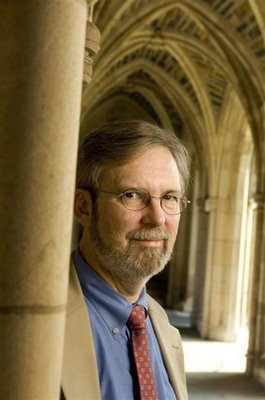
“Ethics in Light of the Resurrection” with Dr. Richard Hays, George Washington Ivey Professor of New Testament at The Divinity School of Duke University. The Willson-Addis Lecture was held Feb. 19 in the Paul W. Powell Chapel at Truett Seminary.
Page gives links to streaming QuickTime or RealPlayer videos
Shaffer’s play may render another service. It alerts us to the danger of misunderstanding the doctrine of the Trinity. Such a misunderstanding is easy, for the language of the church fathers who formulated this doctrine was different from ours, and it defies simple interpretation. This is not the place for a disquisition on the Trinity. One might only suggest that Equus prompts us to look again at the mystery of Christian faith through the analogy of parental, filial and professional conflicts.
God the Father is not the symbol of paternal tyranny, as feminist theologians have sometimes claimed, or as post-Schleiermacher Protestant idealism — paradoxically followed by Freud and Jung — has maintained. These erroneous views of God abusively separate the New Testament from the Old Testament and misinterpret both. God the Father maternally provides and nurses, judges and forgives.
God the Son is not an androgynous youth, fuzzily playing at the extension of consciousness, or a Marxist rebel, compounding injustice in the name of justice.
God the Spirit does not overwhelm with emotional intoxication — although visionary trance and speaking in tongues may have their place in situations of exceptional extremity. The Spirit is the Comforter — that is to say, the Fortifier of communal bonds and the Authenticator of knowledge.
One thing I have learned from the Radical Reformers is that theological thought can never be separated from its embodiment in concrete communities of worship and service. Thus, when asked how my thought has been shaped by engagement with Radical Reformation theology, I must reply-in the spirit of what I have learned from the Anabaptist tradition-that I cannot answer the question without explaining how my life has been shaped by encounter with radical reformation communities.
Paul was a planter of churches (1 Cor 3:6-9), an organizer of far-flung little communities around the Mediterranean that united clusters of disparate people in the startling confession that God had raised a crucified man, Jesus, from the dead and thus initiated a new age in which the whole world was to be transformed. The letters of Paul that survive in the NT are his pastoral communications with these mission outposts. Though separated from them, he continued to offer them exhortation and counsel about how to conduct their common life “worthily of the gospel of Christ” (Phil 1:27).
These general observations about the Pauline mission merely restate common knowledge, but their implications for Pauline ethics have not been sufficiently appreciated. I would like to draw particular attention to their significance for interpreting the moral vision of the Pauline letters. It will be my contention that Pauline ethics is fundamentally ecclesial in character and that we begin to grasp his moral vision only when we understand that he sees the church as inheriting the corporate vocation of God’s covenant people, Israel. Apart from this foundational assumption, Paul’s ethic can only appear to be what many critics have thought it to be: a haphazard conglomeration of moral notions drawn eclectically from the commonplaces of his time.
School of Theology Graduation Ceremony, Charles Sturt University Canberra, Australia
Their hopes were not wrong, just out of focus. They were looking for a prophet mighty in deed and word, like Moses, to lead the people out of bondage; instead, they got Jesus, a prophet mighty in deed and word who died on a cross. This suffering was not in their script, so Cleopas and friend failed to discern what God had done in the resurrection of Jesus, even when the Risen Lord was walking right beside them. Why?
To find out, we must step back in and resume the story.
You have written prolifically on Paul, including your seminal dissertation The Faith of Jesus Christ: The Narrative Substructure of Galatians 3:1-4:11. What first drew your attention to Paul, and how do you see your work on Paul fitting in to the larger context of Pauline scholarship?
My fascination with Paul took shape during my years in the doctoral program at Emory, as a result of seminars with Lee Keck and Hendrikus Boers. I was taking those courses in the immediate wake of the publication of Ed Sanders’ Paul and Palestinian Judaism and J. Christiaan Beker’s Paul the Apostle. These works were raising in different ways questions about Paul’s “pattern of religion” and about the problem of “contingency and coherence” in Paul’s thought. It seemed to me that the way most Pauline scholars approached these issues was driven too much by the quest for an ideationally/systematically formulated “center” of Paul’s thought, with too little attention to the narrative underpinnings of Paul’s teaching. So I began to mull over the ways in which Paul’s letters might be understood to contain allusive references to an underlying story. At the same time, in the seminar with Keck, I wrote a paper on Romans 3, which later became my first published article, a piece in JBL called “Psalm 143 and the Logic of Romans 3.” The germinal insight of the essay was that Ps 143:2, which Paul loosely cites in Rom 3:20, contains in its wider context references to the righteousness of God that help to elucidate the logic of Paul’s argument in Rom 3:21-26. You can see how this led on to further developments as I followed this thread.
Christianity and the Soul of the University: Faith as a Foundation for Intellectual Community? took place March 25-27, 2004 at Baylor University and was sponsored by Baylor’s Institute for Faith and Learning and the Council of Christian Scholarly Societies.
Links to page with streaming QuickTime, Real Player and Windows Media files